
Killing Prepto.Tech
I'm shutting down prepto.tech today.

I’m shutting down prepto.tech today.
The dark-comedy version: shutting down a startup with 0 active users doesn’t really require a shutdown announcement.
The honest version: I want to write down what killed it. I’m writing this for myself first — to publicly admit it failed, to kill the “hope” inside me, to kill the “what if.”
Quick numbers, in case that’s all you came for. Aria launched January 1, 2026 on prepto.tech. Five months later: 50 total users ever, 0 active in the last week, ~1 visit per day with effectively 100% bounce. Beautiful. A masterclass.
How I got there
I’m a Ukrainian founder based in Poland. Backend engineer, 8+ yoe. All of this happened alongside a full-time job — nights, mornings, weekends. I skipped the FAANG-credential path on purpose — I believed I could prove myself as a nobody-founder, by the work, not by the resume. I still believe that’s possible. I no longer believe I demonstrated it with Aria.
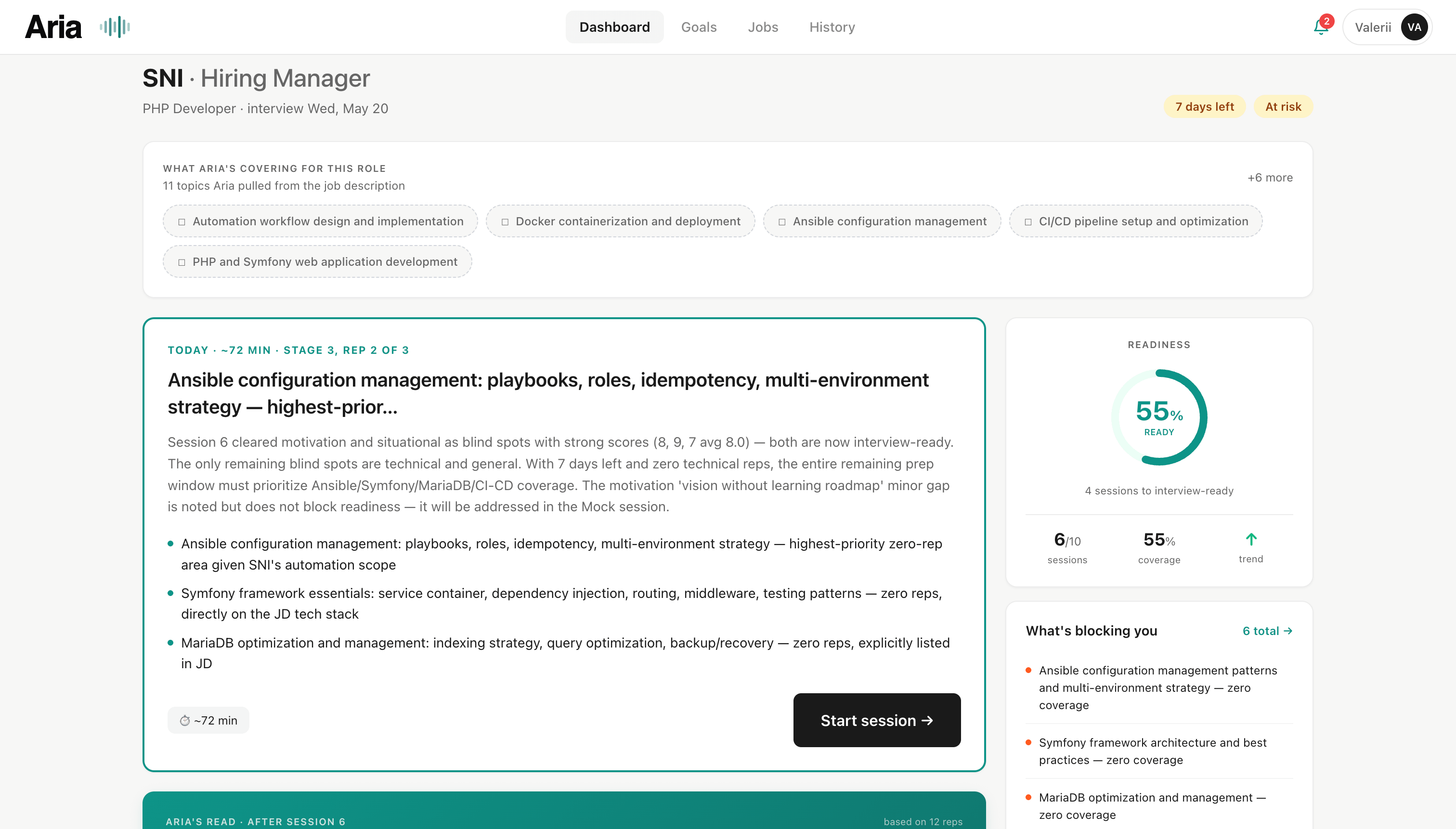
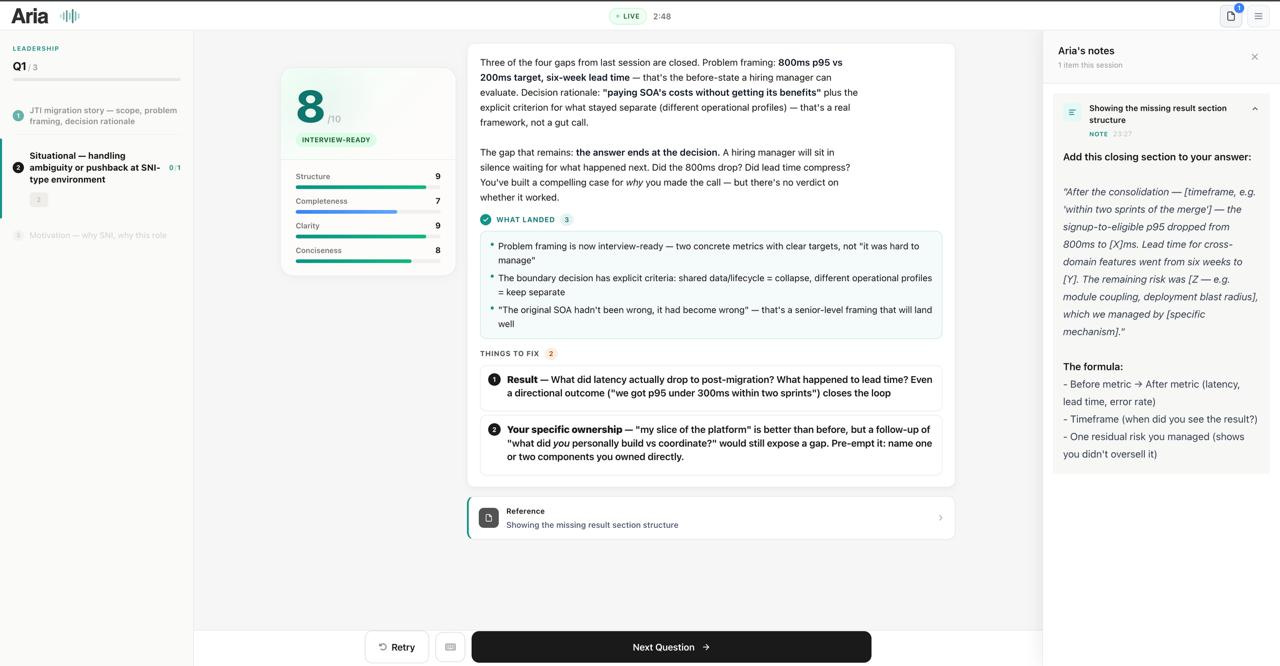
I shipped the first version of prepto.tech in June 2025. It generated static interview Q&As from job descriptions. Cute. Useless. I killed it in December. Then I built Aria — an agent version that talks back, gives feedback, makes you actually practice.
The real plan was bigger than a mock interview tool. Aria was B2C first, B2B2C later. The idea was to replace the resume-and-pray ATS circus with a candidate-first system: one place that holds your resume, the way you actually speak, the job conditions you want, what motivates you, what you’re strongest at. You wouldn’t apply hoping a company notices you before an ATS rejects you in one second — you’d walk into a real conversation with a real company who already knew you as a person, not as a row in their pipeline. The agent would plan and schedule the prep, build a session plan from your resume and the job, run dynamic interviews you couldn’t cheat (rubric scoring + cheat detection were the bridge to making companies trust it), and surface you to companies only when you were actually ready. I fed it research on unemployment psychology and tuned it to give real feedback — not yes-man encouragement. Users told me the feedback was too harsh. I’d still argue failing in a safe environment is better than failing in the interview that mattered. The architecture worked. The thesis didn’t sell.
I applied to YC during this period and got rejected. I tried multiple distribution strategies, including running the Bullseye framework end-to-end. I flew to San Francisco, met great people, fell in love with the place (of course), and got specific advice I’m still following today. None of this saved Aria. It did give me a sharper read on what wasn’t working — which is most of what this post is.

I built Aria because I had talked to a lot of people who told me the real problem with interviews wasn’t knowing the answers — it was the stress, the panic, the inability to communicate when it mattered. People said this. I believed people. I built Aria.
This was my first mistake. People say things. People also do things. The two are not the same.
The nine things that actually killed it
People don’t acknowledge the problem. Not really. Ask them in conversation: yes, interviews are stressful, yes, communication matters. Ask them what they currently do about it: nothing. They post on Reddit, they talk to friends, they drink, they muddle through. The “active solution-seeking” condition that Steve Blank says you need from a customer? Absent.
People get offers with bad interviews and bad CVs and conclude “that’s how it’s supposed to work.” They attribute their success to themselves, not to randomness. Why would they buy something to fix what, in their model, isn’t broken?
The end-state of my product was the absence of need for my product. A great interview-prep tool helps you get a job. Then you don’t need it anymore. Subscription economics on a product designed to make itself obsolete are bad. I knew this from the start. I built it anyway. I told myself the LTV would compound through retention. Reader, it did not.
Distribution is hard because it’s coaching for high-stakes conversations without trust. You cannot cold-DM someone “hey, I built a thing to help with the most psychologically loaded part of your career, want to try it?” and expect anything but silence. Trust takes time to build. I didn’t have time and I didn’t have patience.
Retention is terrible even when people invest in the first session. People showed up. Some did the first session. Almost nobody came back. The product didn’t earn the second visit. That’s not a marketing problem. That’s a product problem I didn’t know how to solve.
The biggest market is FAANG candidates, but it’s saturated and AI-adapted. Every product in the space launched AI features in 2024. I was late. Late and undifferentiated.
I had no access to hiring-side insights. I built from candidate-side conversations only. So when push came to shove, the product couldn’t articulate why it was better than free ChatGPT — because I didn’t actually know what good interviews evaluate from the company’s side. I was guessing.
Free ChatGPT exists. Why would anyone pay? I never had a good answer to this. I had marketing answers. I had “Aria has structured feedback loops.” I didn’t have an answer that an unemployed engineer with no income would find compelling enough to pull out a credit card.
Identity-threatening products are hard to sell. This is the deepest one. Aria gives harsh feedback. It points at the bullshit answers and asks why. It does not let you skip past the part where you’re not yet good enough. People generally do not pay to confirm their own inadequacy. They pay to feel competent. The retry loop did show real improvement between attempts — so the product itself does something, the architecture works — but the buying psychology runs against you the whole way.
The thing I’m angrier about than any of the nine
I built Aria from what people told me they wanted. I had no problem of my own to solve here, and I couldn’t see a mechanism the rest of the market was missing. What I had was a story I’d heard people repeat — “interview stress is the real problem” — and I trusted it more than I trusted my own read.
This is the most common failure mode in first-time founding. There’s a whole book about it (The Mom Test). I had read it. I built the failure mode anyway, with the book on my shelf.
I thought I was the messiah educating the market. I’d say “people don’t realize what good prep looks like” and feel smart for noticing. The market, very politely, did not need me to educate it. The market is fine. I’m the one who needed to listen better.
Three other forms of the same mistake, in case the first one wasn’t specific enough:
I tried to do everything for everyone. I never narrowed. Junior engineers, senior engineers, career switchers, FAANG candidates, non-FAANG, US, Europe — the audience was “people who interview,” which is to say everyone, which is to say nobody. Every successful product I respect was painfully narrow at the start. I knew this. I refused to apply it because narrowing felt like admitting the dream was smaller than I wanted.
My social activity was 90% promotion, 10% genuinely showing up. Should have been the inverse. I treated communities as distribution channels instead of places where people actually live, and people felt it instantly. I’d drop into a forum to plug Aria, leave, drop into another one a week later. I never stayed anywhere long enough to be recognizable as a person rather than a pitch. The result was the obvious one — I felt like an outsider performing a job called “being social,” and the audience felt it too. Depression compounded on top.
My landing page was indistinguishable from a weekend vibecoded project. I saw this clearly only after I visited a competing prep tool someone had built in two days and realized I couldn’t tell our landings apart. Mine talked about features — “look at this cool thing I built!” energy. I couldn’t say “business” or “service” with a straight face — it was a hobby with a Stripe integration. If the landing page can’t tell a stranger why they should care in five seconds, the product can’t either, no matter what the architecture does inside.
The Naruto problem
Here’s the part I find hardest to write. My whole identity around this work is “I don’t give up.” I read manga as a kid. I internalized the lesson. I have used “I don’t give up” to push through every previous failure in my life — including some that were genuinely worth pushing through, and some that were not.
Killing Aria today feels, in my body, like giving up. Even though I can construct, with full intellectual honesty, the argument that this is the right move and grinding harder would be the wrong one.
This is what I wish someone had told me earlier: the courage to keep going and the courage to let an idea die look identical from the inside. They both feel like betraying yourself. The difference between them is whether the underlying reality supports continued investment, and that’s a calculation you have to make outside the feeling.
For Aria, the reality does not support continued investment. The buyer doesn’t have money, the alternatives are free, the product is identity-threatening, and I have no domain access on the side of the market that does have money. No amount of conviction beats that arithmetic.
What I’m taking with me
A few things, since I’m here:
Business is a function. You see a problem, you think it through, you ship, you measure, you adjust. The hype around it is decoration; the founder identity around it is decoration; the function itself is the thing. The sooner you treat founder work like the engineering you already do well, the less it will eat you.
Everywhere are people. The “users” and “customers” and “leads” are shorthand we use so we can think about humans like inventory — and they are not inventory. If you don’t talk to them as people, they will smell it instantly, and they will be right.
The conviction-vs-delusion test is whether you can articulate the one specific non-obvious thing you see that the analytical view misses. If you can name it, conviction has substance. If you reach for vibes when you try to name it — your conviction is identity, not insight.
You can solve hard personal problems with discipline and kill criteria. I lost weight years ago and stayed lost. The same discipline applied to a problem you actually have, in a market you actually understand, will compound. The wrong target was the issue, not my capacity to execute on it.
What’s next
I do have an idea for what to build next, still in the hiring space. I’m not going to start with code this time. I’m going to spend months talking to people, doing the research, sharing what I find as I find it. I want to understand the exact workflow that’s broken, how I’d actually fit into someone’s daily routine, and how I’d solve a painful problem for a small specific group of people or companies — not for everyone.
The plan is lean. Learn, and give. I’ll skip the viral-post hopium and the “buy my startup” DMs. Show up where the problem actually lives. Contribute something useful before asking for anything. Stay long enough that people can tell I’m a person, not a pitch.
Will I repeat one of the mistakes above? Almost certainly. Will I repeat all of them? I don’t think so. I’ve at least paid for the education.
Before that starts, I’m taking some real time off — off in the actual sense, not the founder-vacation sense where you’re still strategizing in the shower. I want to feel that an idea I cared about didn’t work before I rush into the next one.
If you’re in a similar place: the math doesn’t lie. But the math also doesn’t tell you who you are. Both are true at the same time.